Why Tractor Financing Is the Smart Way to Get the Equipment You Need
Tractor financing is the process of borrowing money — or using a lease — to purchase a tractor, then repaying it over time instead of paying the full price upfront.
Here’s a quick overview of how it works:
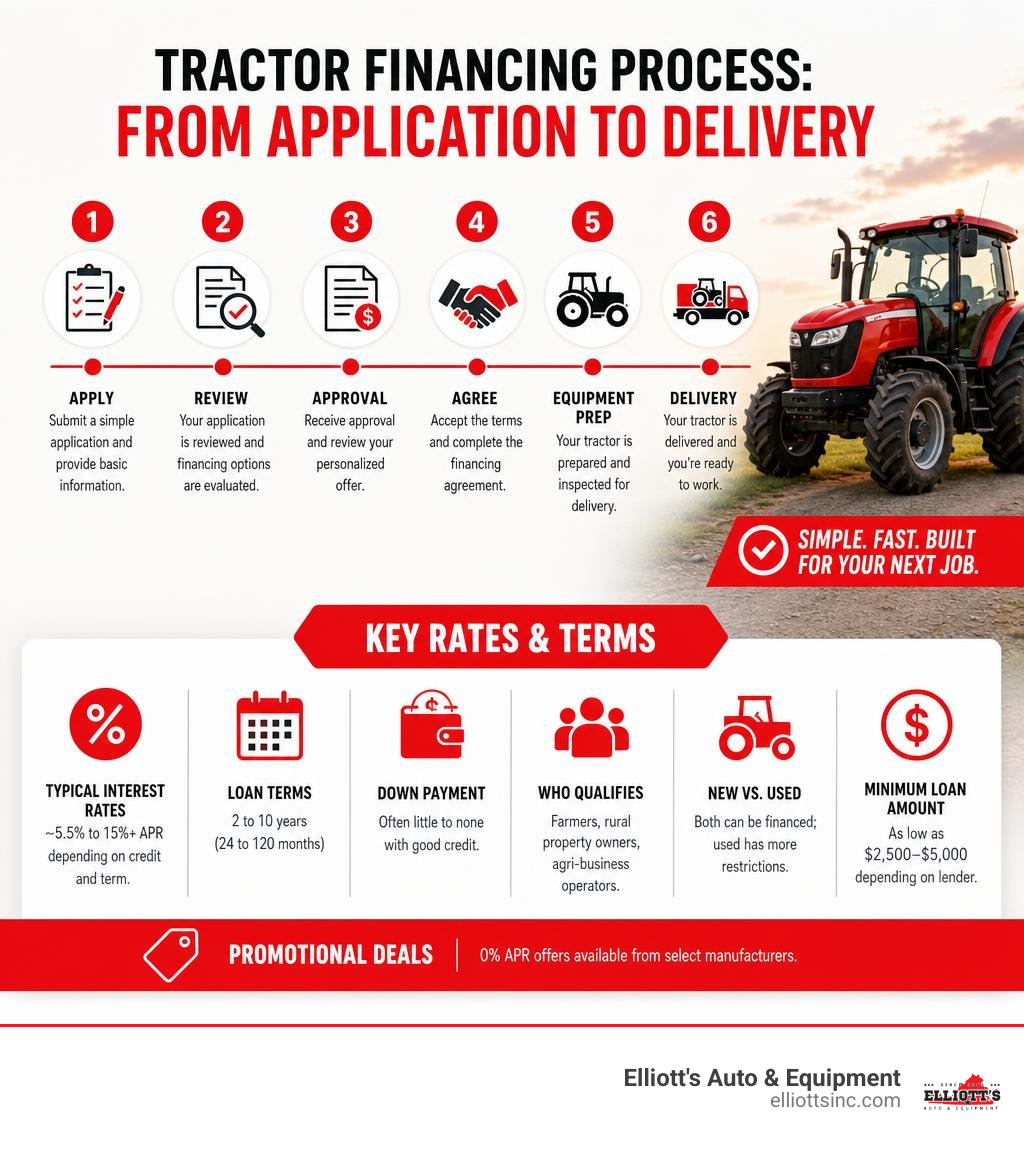
| What You Want to Know | Quick Answer |
|---|---|
| Main options | Loans, leases, dealer financing, third-party lenders |
| Typical interest rates | ~5.5% to 15%+ APR depending on credit and term |
| Loan terms | 2 to 10 years (24 to 120 months) |
| Down payment | Often little to none with good credit |
| Who qualifies | Farmers, rural property owners, agri-business operators |
| New vs. used | Both can be financed; used has more restrictions |
| Minimum loan amount | As low as $2,500–$5,000 depending on lender |
| Promotional deals | 0% APR offers available from select manufacturers |
Buying a tractor outright is expensive. A single compact utility tractor can run $15,000 to $50,000 or more. That’s a big hit to your cash reserves — especially when you still need to cover seed, fuel, labor, and repairs.
That’s why 7 out of 10 equipment buyers choose financing over paying cash. It preserves working capital while still putting the right machine in your hands today.
Whether you’re a first-time buyer or looking to upgrade aging equipment on your rural property, understanding your financing options can save you thousands and protect your cash flow.
At Elliott’s Auto & Equipment in South Boston, Virginia, we’ve helped rural property owners navigate tractor financing for years — matching customers with the right equipment and the payment plans that fit their budgets. We’re here to make the process simple, not stressful.
Understanding Your Equipment Financing Options
When you decide to purchase a tractor, you aren’t locked into a single pathway to ownership. There are multiple ways to structure your purchase, and choosing the right one depends heavily on your tax strategy, how long you plan to keep the machine, and your current cash reserves.
Equipment Loans vs. Equipment Leases
The two primary vehicles for acquiring a tractor are installment loans and leases.
- Equipment Loans: With a standard installment loan, you borrow a set amount of money to purchase the tractor. You own the equipment from day one, and the lender holds a lien on the tractor as collateral. Once you make the final payment, the lien is released. This is the most common path for long-term ownership, allowing you to build equity and take advantage of Section 179 tax depreciation write-offs.
- Equipment Leases: Leasing is essentially a long-term rental agreement with an option to buy at the end. Operating leases often feature lower monthly payments and allow you to walk away or upgrade to a newer model when the term ends. Capital leases, on the other hand, function similarly to loans, often ending with a nominal purchase option (like a $1 buyout). Leases can free up working capital and are highly favored by commercial operations looking to keep their balance sheets light.
Dealer Financing vs. Third-Party Lenders
Where you get the money is just as important as how the deal is structured.
- Dealer Financing: This is arranged directly at the point of sale. Dealerships partner with manufacturer-owned “captive” finance companies or preferred national lenders to offer highly competitive, streamlined financing.
- Third-Party Lenders: These include commercial banks, local credit unions, and specialized agricultural lenders like AgDirect: Farm Equipment Financing . Going this route requires you to secure pre-approval independently before you go shopping.
Manufacturer and Dealer Tractor Financing
Opting for manufacturer-backed financing (often called “captive finance”) is incredibly popular because of the sheer convenience and the aggressive promotional rates available. Captive lenders exist to help dealers sell tractors, which means they frequently roll out incentives that independent banks simply cannot match.
If you are looking to buy a new machine, you will often find promotional offers like 0% APR for 60 to 84 months. These plans allow you to spread the cost of the tractor over five to seven years without paying a single penny of interest.
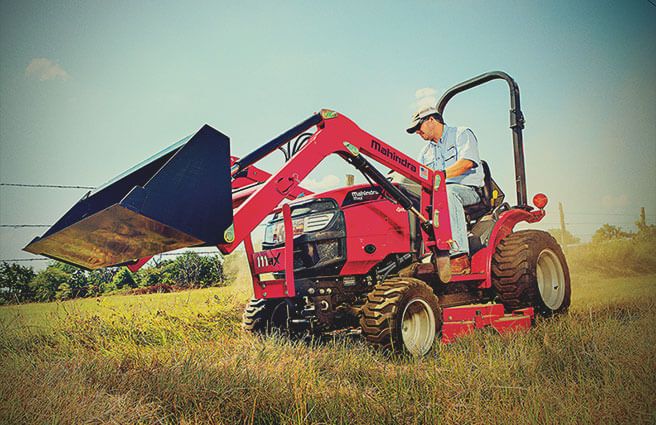
When considering these incentives, it is highly beneficial to look at brands known for offering exceptional value. For example, if you are researching why a particular brand might be the right fit, you can read our guide on Why Should You Buy a Mahindra Tractor? to see how these heavy-duty, cast-iron machines stack up. Additionally, exploring the Top 5 Reasons Mahindra Tractors excel in the field can help you understand why pairing Mahindra’s legendary pulling power with competitive dealer financing is such a popular choice for Virginia landowners.
Third-Party Lenders and Credit Unions
While manufacturer financing is fantastic for new equipment, third-party lenders shine when you are looking for maximum flexibility, variable rate options, or when you are purchasing used equipment from private parties or auctions.
- Specialized Ag Lenders: National programs like AgDirect: Farm Equipment Financing are built specifically for the agricultural industry. They understand that a farmer’s income isn’t always a steady bi-weekly paycheck, offering terms from two to seven years with highly customizable payment structures.
- Agricultural Credit Cooperatives: While regional cooperatives like Southern AgCredit Farm Loans serve growers in other parts of the South, similar agricultural credit associations and local banks support Virginia growers with specialized land and equipment packages.
- Credit Unions and Banks: Local institutions often provide excellent customer service and competitive rates. For instance, looking at national averages, credit unions might offer compact tractor rates ranging from 5.51% for 48 months up to 7.00% for longer terms of 73 to 84 months.
Interest Rates, Terms, and Down Payment Requirements
Your interest rate, loan term, and down payment requirements are closely linked. Lenders look at your credit profile, the age of the tractor, and how much skin you have in the game (your down payment) to determine your final rate.
Here is a general breakdown of what you can expect in the current July 2026 lending landscape:
| Loan Type | Typical APR Range | Common Terms | Down Payment Requirement |
|---|---|---|---|
| Manufacturer Promo (New) | 0.00% – 4.99% | 24 – 84 Months | 0% – 10% (Subject to credit approval) |
| Standard Dealer Rate (New) | 5.99% – 8.99% | 24 – 120 Months | 10% – 20% |
| Used Equipment Loan | 6.50% – 11.99% | 24 – 84 Months | 15% – 25% |
| Sub-Prime Financing | 10.99% – 14.99%+ | 36 – 60 Months | 20%+ or equivalent trade-in |
Understanding the Fine Print: APR vs. Stated Rate
When evaluating promotional offers, pay close attention to the Annual Percentage Rate (APR) versus the advertised interest rate. Many “0% APR” or low-interest programs require a one-time documentation or origination fee.
For example, major industry lenders like Sheffield Financial, ACUSI, or Dealer Direct routinely charge documentation fees ranging from $99 to $150. When these fees are added to the financed amount, they create a small difference between a 0% interest rate and the actual effective APR (which might sit around 0.35% to 0.78%). Always read the disclosures to ensure you understand the total cost of borrowing.
Aligning Repayment Schedules with Crop Cycles
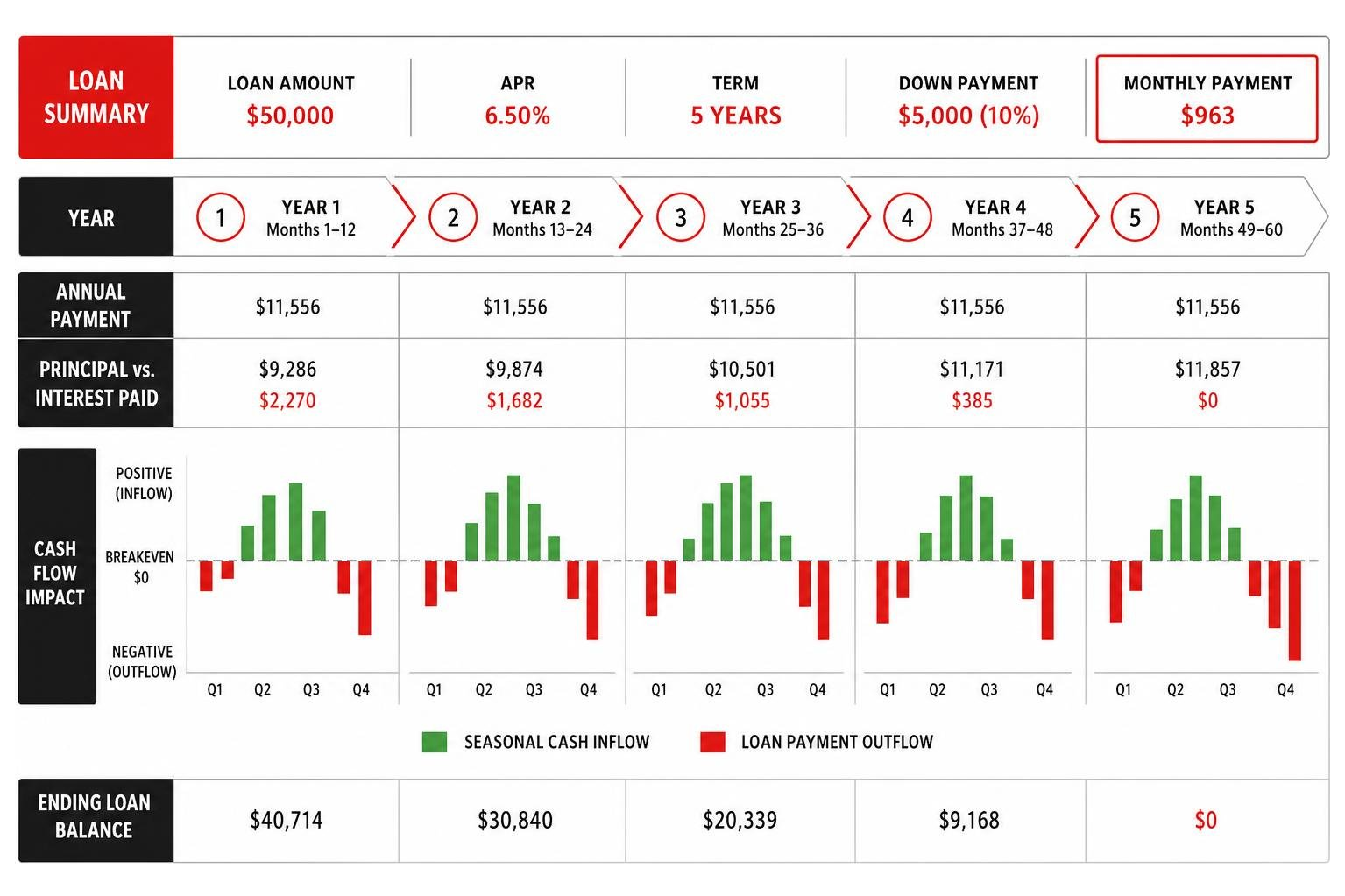
One of the most significant benefits of dedicated tractor financing over a standard auto loan is the ability to customize your repayment schedule. Lenders who specialize in agricultural equipment understand that cash flow in farming is highly seasonal.
If your income relies on a fall harvest, a traditional monthly payment schedule can put an unnecessary strain on your bank account during the spring planting season. To solve this, specialized lenders offer several flexible payment structures:
- Monthly Payments: Best for hobby farmers, commercial landscapers, or rural landowners with steady, non-seasonal off-farm income.
- Quarterly Payments: A great middle-ground for operations with rolling livestock sales or steady regional crop cycles.
- Semi-Annual Payments: Aligns perfectly with double-cropping systems or bi-annual livestock marketings.
- Annual / Seasonal Payments: Designed specifically for cash-crop operations. You make one major payment per year, timed precisely to coincide with your primary harvest payouts.
Eligibility, Credit Criteria, and Equipment Standards
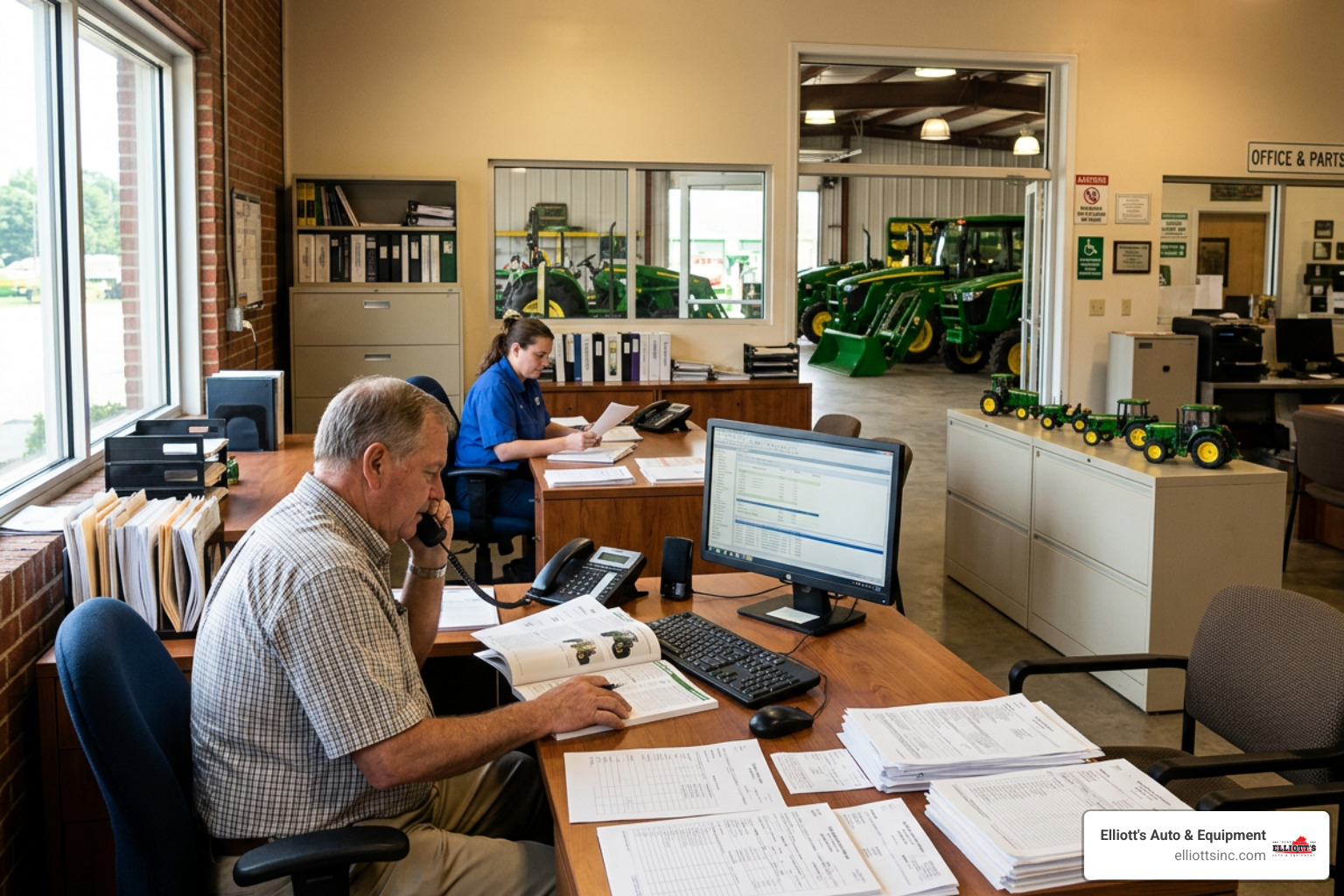
Getting approved for tractor financing is straightforward if you know what lenders are looking for. While every financial institution has its own underwriting standards, most rely on a core group of metrics to evaluate your application.
- Credit Score (FICO): For top-tier promotional rates (like 0% APR), lenders typically look for a FICO score of 700 or higher. However, solid tier-two programs exist for scores between 650 and 690. If your score is below 650, you can still secure financing, but you should expect higher interest rates, standard origination fees, and a mandatory down payment.
- Debt-to-Income (DTI) / Cash Flow: Lenders want to see that your farm or household income can comfortably cover the new tractor payment alongside your existing debts. For commercial agricultural loans, they will evaluate your Debt Service Coverage Ratio (DSCR).
- Collateral Value: In most cases, the tractor itself serves as the collateral for the loan. This is why lenders are highly specific about the equipment’s condition. New tractors are easy to finance because their value is clear. Used equipment requires closer inspection; lenders will verify the hours, model year, and overall condition to ensure the tractor’s market value exceeds the loan balance. To help you determine what size and style of machine fits your land’s physical demands, check out our comprehensive guide: How to Choose the Perfect Tractor for Your Farm: A Beginner’s Guide.
Essential Documentation for Tractor Financing Applications
To make the application process as fast and seamless as possible, it is smart to gather your paperwork before heading to the dealership. Having these items ready can turn a multi-day approval process into a matter of hours.
- Proof of Identity (KYC): A valid driver’s license, state ID, or passport to satisfy “Know Your Customer” legal requirements.
- Tax Returns: Typically, the last two years of personal and business federal tax returns (including Schedule F for farming operations).
- Bank Statements: The most recent three to six months of bank statements showing operating capital and steady cash flow.
- Proof of Land Ownership or Lease: A copy of your property deed, property tax bill, or active agricultural land lease agreement.
- Official Equipment Quotation: A detailed write-up from your dealer showing the exact tractor model, serial number, purchase price, and any included attachments.
Financing Tractor Attachments and Implements
A tractor is only as useful as the tools you hang off the back of it. Whether you need a front-end loader to move gravel, a rotary tiller to prep your soil, or a post-hole digger for fencing, these attachments are essential to getting your work done.
The good news is that you do not have to pay cash for your implements. Nearly all lenders allow you to bundle attachments directly into your primary tractor financing package.
Bundling your implements into a single loan is highly advantageous. It allows you to secure the same low promotional interest rate (even 0% APR) for your entire setup, saving you from high-interest credit card debt or secondary loans.
At Elliott’s Auto & Equipment, we frequently help customers build complete, ready-to-work packages. A popular combination for local landowners is pairing a rugged Mahindra utility tractor with a high-performance zero-turn mower. You can learn more about how these machines complement each other by reading about The Power Duo: Mahindra Tractors & Hustler Mowers.
Note on Mowers: While we love helping customers compare different options — such as providing used-market guidance or parts support for brands like Cub Cadet — please note that Elliott’s Auto & Equipment only sells new Hustler zero-turn lawn mowers for residential and commercial customers. This ensures you get the absolute highest quality, commercial-grade cut with the best warranty protection available.
Frequently Asked Questions About Tractor Financing
Is physical damage insurance required when financing a tractor?
Yes. Because the tractor serves as the collateral for your loan, virtually all lenders require you to maintain physical damage insurance throughout the entire life of the contract. This insurance must cover comprehensive risks, including accidental damage, collision, fire, and theft.
You generally have two ways to satisfy this requirement:
- Dealer/Manufacturer Insurance: Many manufacturers offer specialized, convenient equipment insurance programs that can be bundled directly into your monthly payment. These policies are highly specialized and often cover transport risks and off-property damage that standard homeowners policies exclude.
- Private Insurance Rider: You can contact your existing farm insurance or homeowners insurance provider to add an inland marine rider to your policy, naming the lender as the loss payee.
Can I finance a tractor purchased from a private party or auction?
Yes, but it is more complicated than financing through a licensed dealership. Lenders like AgDirect offer specialized private-party and auction financing programs, but they enforce strict rules:
- Minimum Value: The transaction must meet a minimum purchase threshold, which is typically $5,000.
- Clean Title Only: The equipment must have a verifiable, clean title history. Any titled assets (like heavy transport trailers or larger Class 6+ trucks) marked as “Salvage,” “Reconstructed,” or “Restored” are completely ineligible for financing.
- No Ineligible Assets: Certain items are excluded from third-party ag financing, including residential riding lawn mowers, consumer-use ATVs/UTVs, or stationary buildings.
What happens if I miss a payment or want to pay off my loan early?
Life happens, and agricultural income can be unpredictable. If you anticipate missing a payment due to a delayed harvest or unexpected repair bill, the absolute best course of action is to contact your lender immediately. Most reputable agricultural lenders are willing to work with you to restructure your payment schedule or defer a payment rather than initiating repossession. Delayed payments without communication will result in late fees, penalty interest rates, and damage to your credit score.
If you find yourself with extra cash and want to pay off your loan early, you are usually in luck. Most modern tractor loans do not carry prepayment penalties, meaning you can pay off the principal early and save significantly on interest. However, always confirm this with your dealer or read your loan contract’s fine print before signing.
Conclusion
Acquiring a tractor is a major milestone for any farm, estate, or rural property owner. By utilizing tractor financing wisely, you can protect your hard-earned cash reserves, take advantage of incredible promotional rates, and get the exact machine you need to manage your land effectively.
At Elliott’s Auto & Equipment, we are proud to serve South Boston, Virginia, and the surrounding communities. As a full-service dealership, we don’t just sell equipment — we partner with you for the long haul. From helping you choose the perfect Mahindra tractor, Hustler zero-turn mower, or Big Tex trailer, to providing seamless in-house financing, parts, and expert service, we handle everything right here under one roof.
To help you get started on your ownership journey, explore our local resources:
- Learn about our regional footprint and services with our guide to Tractor and Mower Sales Services in Chase City VA – Elliots Auto Equipment.
- Make sure you are partnering with the right team by reading How to Choose the Right Tractor Dealer for Your Land Management Needs.
- Discover what makes us the area’s premier choice at Trusted Mahindra Tractor Dealer in South Boston VA for Work and Land Management.
- See how we keep you running smoothly year-round with our tips on How Tractor Dealerships Can Simplify Equipment Maintenance.
If you are local to South Boston, VA, or planning a trip near the Home South Boston True Value South Boston, VA (434) 572 … , we invite you to stop by our showroom. You can find our exact location and directions via Elliott’s Auto & Equipment – South Boston .
Ready to see what we have in stock? Explore our inventory and apply for financing today to take the first step toward bringing home your next powerhouse machine.